

CASE STUDY
Simplifying Wealth Management Funding & Asset Transfers
SUMMARY
PNC Wealth Management clients relied on fragmented tools and operational support to fund investment accounts across multiple transfer methods, including internal transfers, ACAT transfers, wires, and rollovers.
As the sole designer supporting the Money Movement team, I led the design of a unified funding framework — restructuring how funding workflows are accessed, executed, and scaled across the platform.
This work consolidated disparate experiences into a centralized system, reduced reliance on operational support, and established reusable patterns for financial transactions across the product.
CASE STUDY
Simplifying Wealth Management Funding & Asset Transfers
SUMMARY
PNC Wealth Management clients relied on fragmented tools and operational support to fund investment accounts across multiple transfer methods, including internal transfers, ACAT transfers, wires, and rollovers.
As the sole designer supporting the Money Movement team, I led the design of a unified funding framework — restructuring how funding workflows are accessed, executed, and scaled across the platform.
This work consolidated disparate experiences into a centralized system, reduced reliance on operational support, and established reusable patterns for financial transactions across the product.
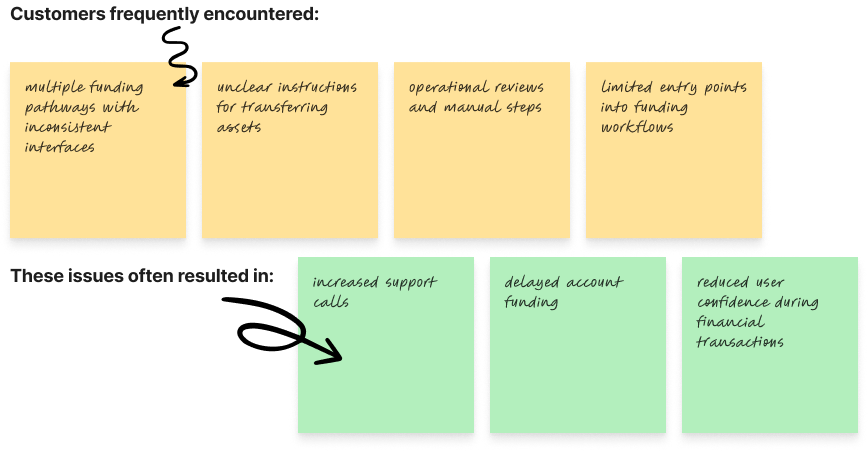
The Problem
Funding and transferring assets into investment accounts is one of the most critical — and high-risk — actions in wealth management.
However, the existing experience was fragmented across multiple tools and required significant operational support for completion.
In a domain where trust, accuracy, and clarity are essential, clients struggled to complete these workflows independently.
WHY THE PROBLEM WAS COMPLEX
Designing money movement systems introduces constraints that directly shape the experience:
Regulatory Constraints
Validation, authorization, and audit requirements needed to be embedded directly into the experience, limiting how much complexity could be removed vs. surfaced.
Cross-Institution Dependencies
External transfers (ACAT) required coordination across financial institutions, introducing uncertainty, delays, and failure points.
Operational Review Processes
Certain money movement transactions required manual verification, requiring the system to support both automated and assisted paths.
Multiple Funding Methods
Each method introduced different rules, timelines, and documentation requirements, increasing decision complexity.
Legacy Platform ConstraintsThe solution needed to integrate into an existing wealth platform while maintaining consistency across financial services.
The challenge was not just simplifying the experience — but restructuring it in a way that preserved safeguards while reducing cognitive and operational friction.
Design Strategy & System Approach
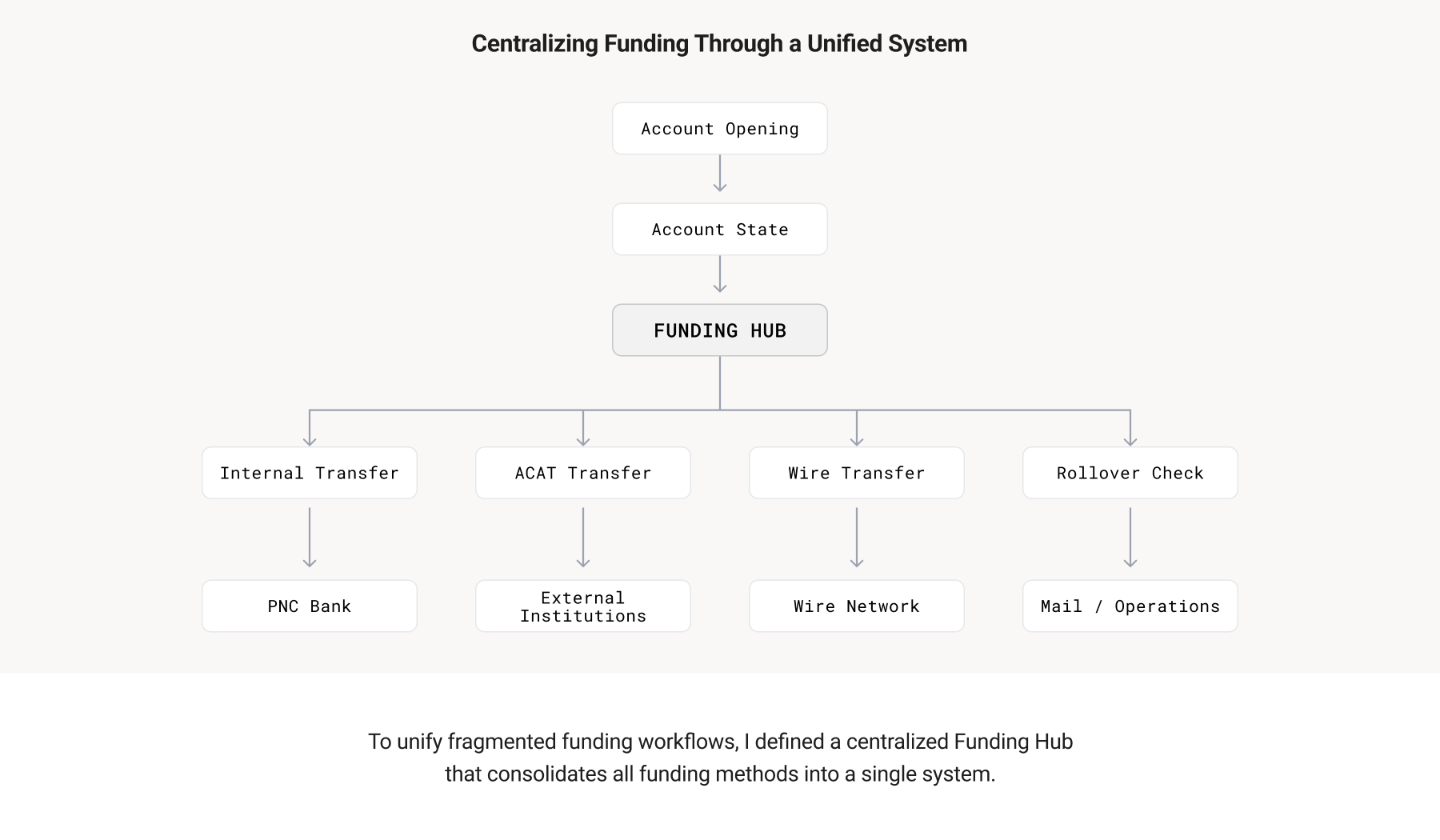
Rather than optimizing individual flows, I restructured how funding decisions are made and executed at a system level.
Core Principles
Centralize fragmented entry points into a unified decision layer
Replace disconnected workflows with a single, structured entry point for all funding actions.
Transform complex processes into guided execution flows
Break high-risk transactions into sequential, decision-based steps that reduce cognitive load and improve completion.
WHAT I CHANGED AT THE SYSTEM LEVEL
• Multiple entry points → Single decision-driven Funding Hub
• Static selection menus → Guided decision-making based on user context
• Backend validation → Inline system-driven validation and authorization
This shifted complexity out of the user experience and into the system — enabling safer, clearer execution of high-stakes transactions.
BREAKING DOWN THE ACAT TRANSFER SYSTEM
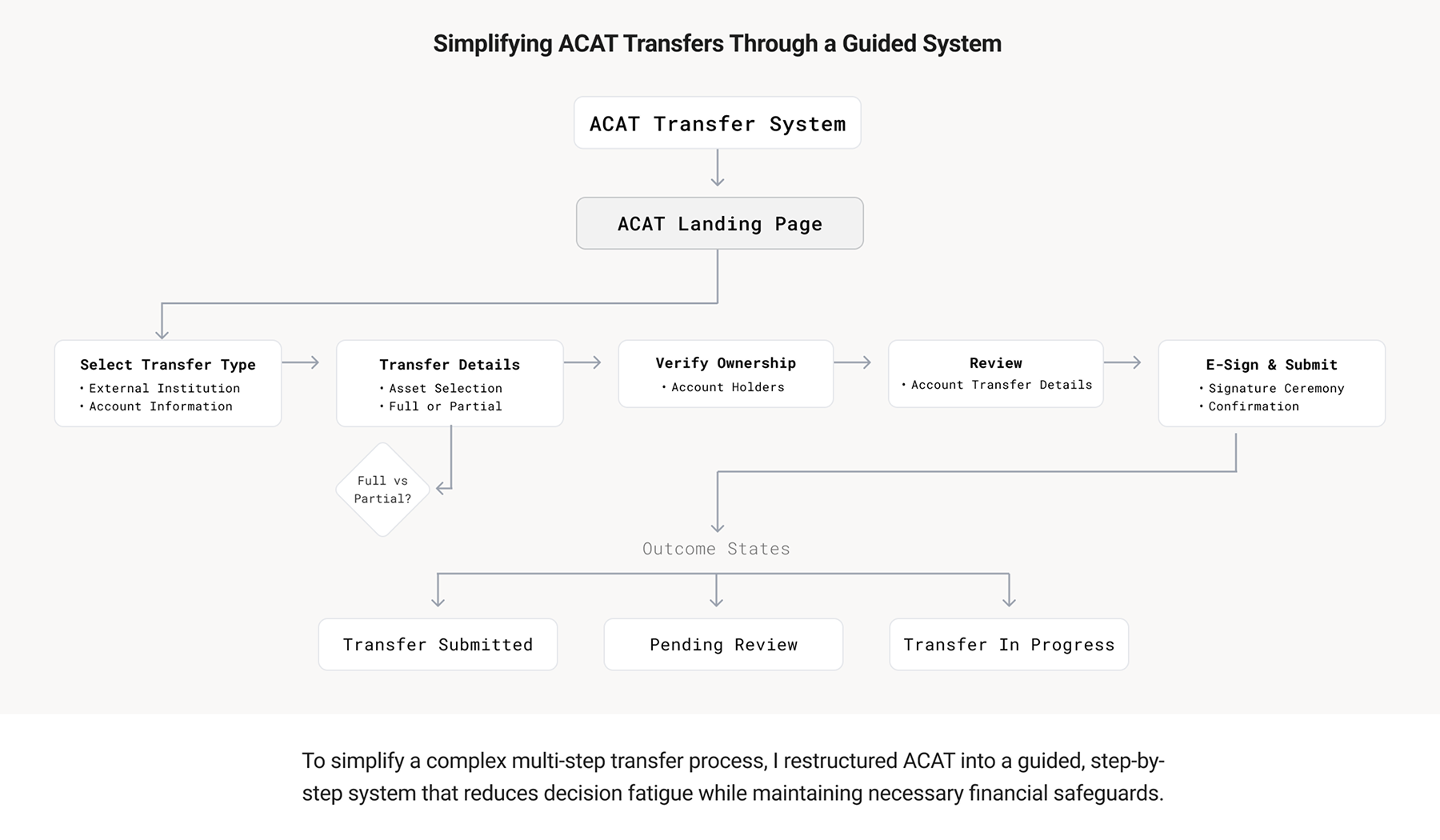
Before designing the experience, I mapped the ACAT workflow into its core structure of inputs, outputs, and dependencies across each stage.
This surfaced:
• hidden decision points
• failure risks
• unnecessary operational dependencies
This analysis informed how the experience could be simplified without removing critical safeguards.
SYSTEM-LEVEL DECISIONS
To support scalability and consistency across workflows, I defined a set of system-level patterns:
Centralized funding actions
Unified access point across all funding methods.
Structured decision layers
Clear sequencing of high-risk steps to reduce errors.
Standardized authorization patterns
Reusable digital signature and approval flows.
Persistent access model
Funding available beyond onboarding, supporting ongoing account activity
SOLUTION PART 1 - THE FUNDING HUB
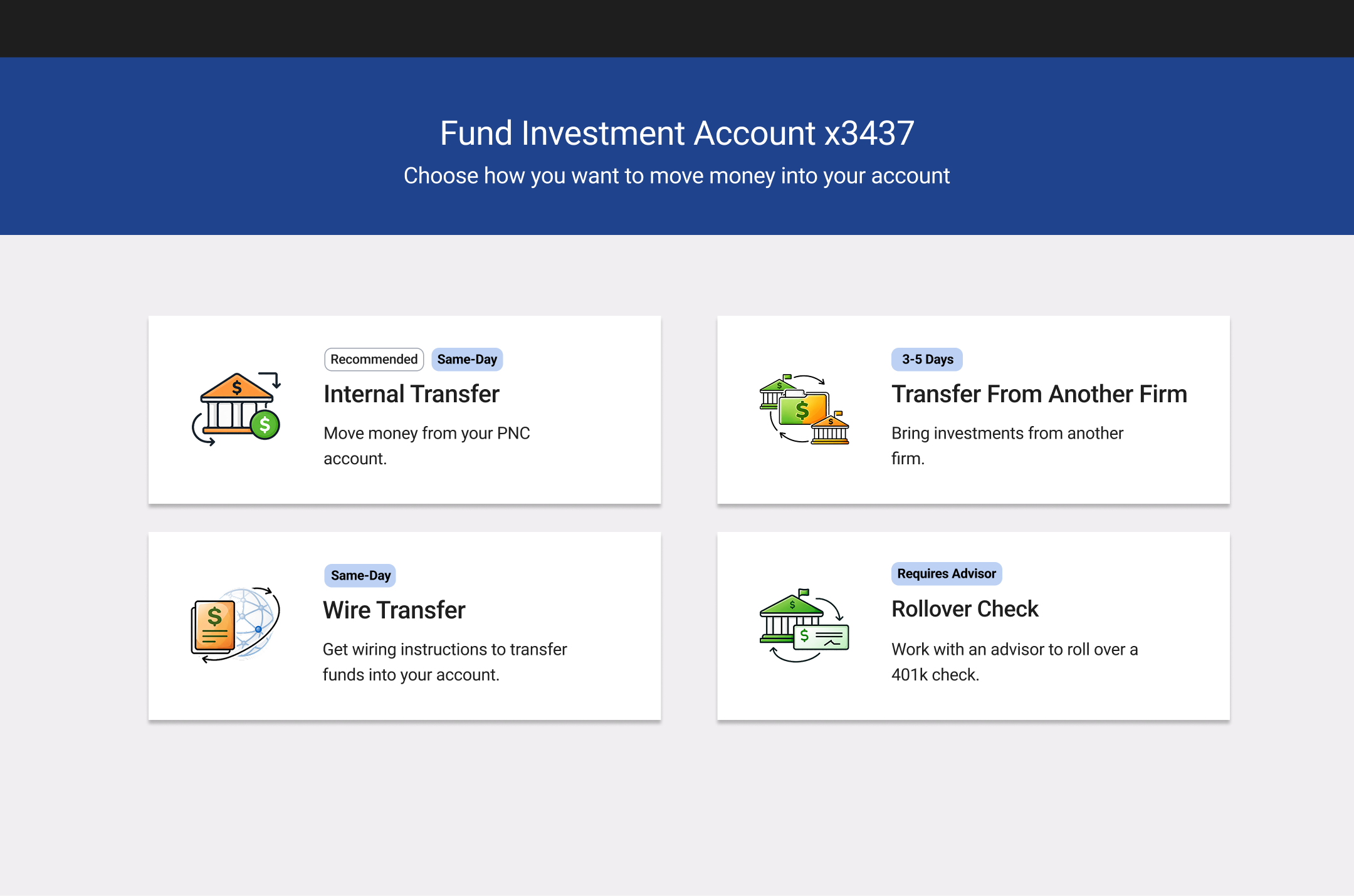
Transformed fragmented entry points into a centralized Funding Hub designed as a decision system, not a menu.
Instead of requiring users to understand funding methods upfront, the system surfaces key decision factors such as:
• speed
• complexity
• required support
This enables users to quickly identify the appropriate funding path based on their situation.
The system was designed to scale — supporting future enhancements such as dynamic recommendations and contextual guidance.
SOLUTION PART 2 - ACAT TRANSFER WORKFLOW
To simplify a complex multi-step financial process, I structured the experience into decision layers, each resolving a critical validation, risk, or execution dependency.
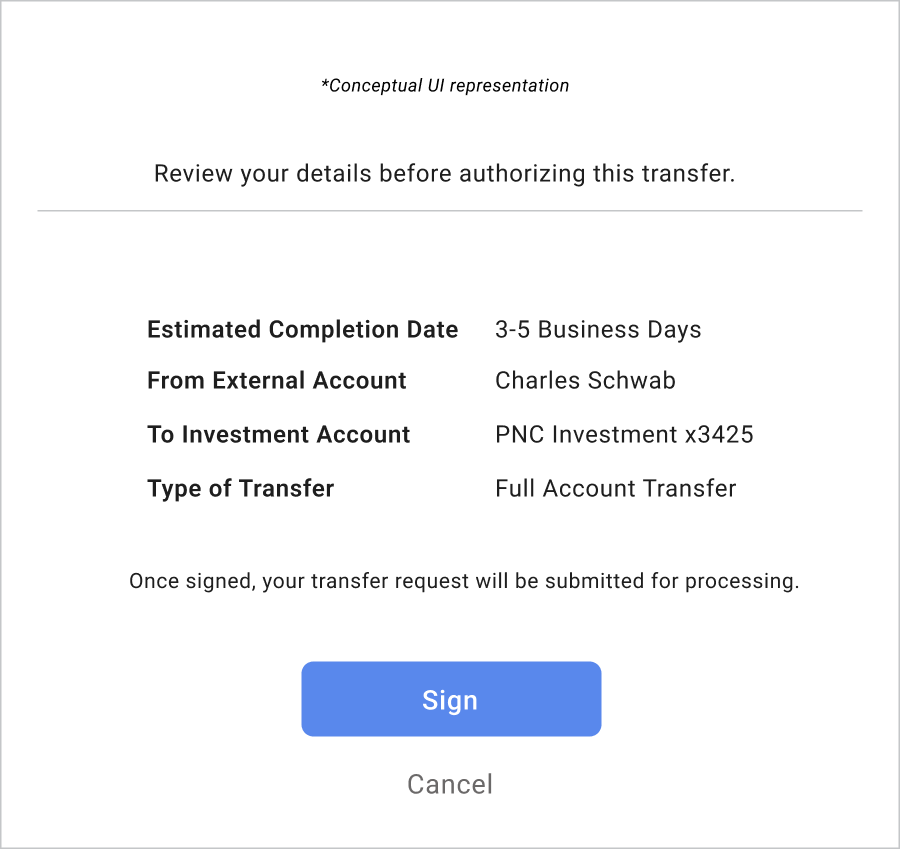
*Production workflow visualized using conceptual UI. Original designs omitted due to confidentiality.
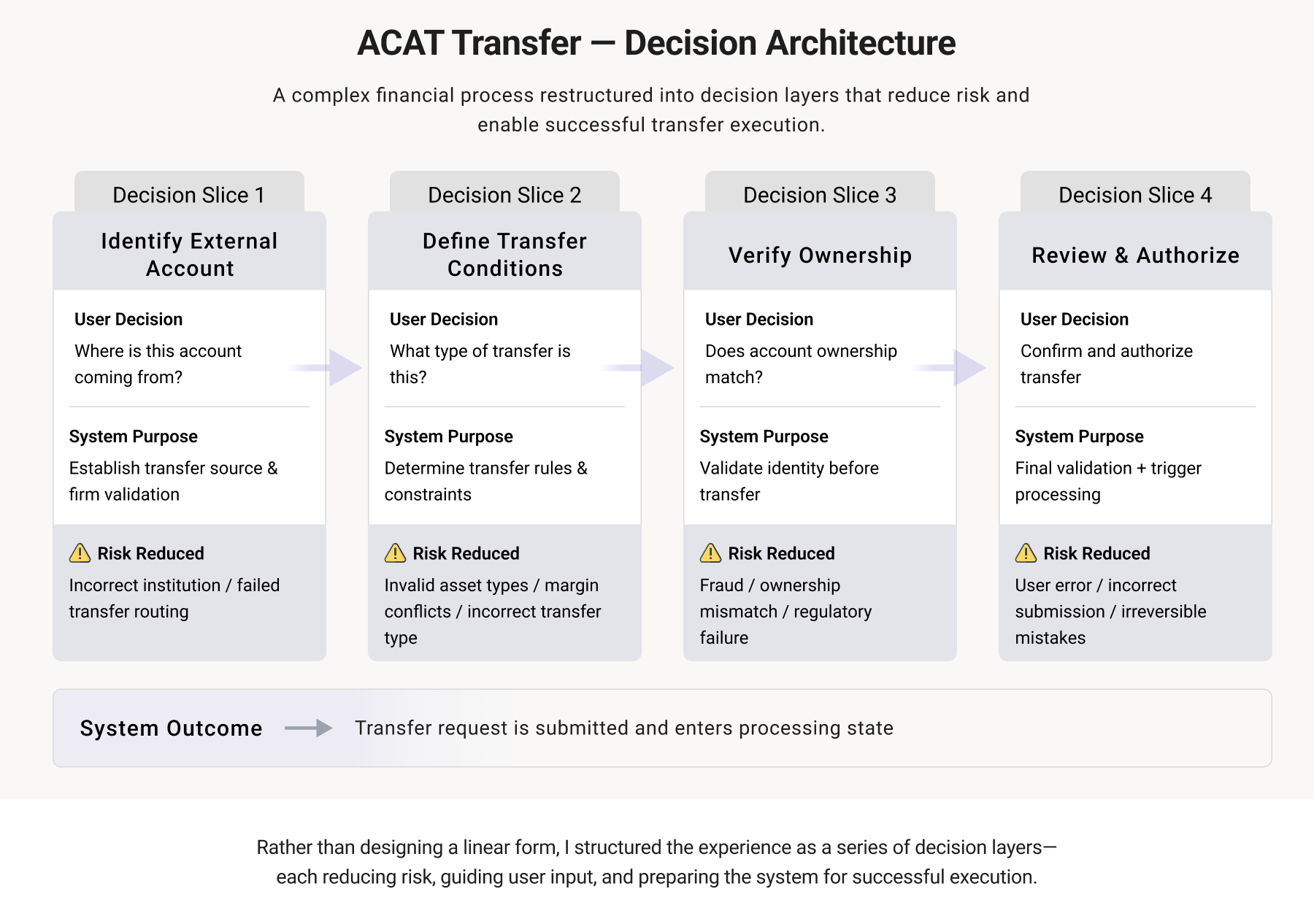
*Due to the sensitive nature of financial workflows, original UI cannot be displayed. The following decision slices reconstruct the system using simplified visuals while preserving the real logic, constraints, and design decisions.
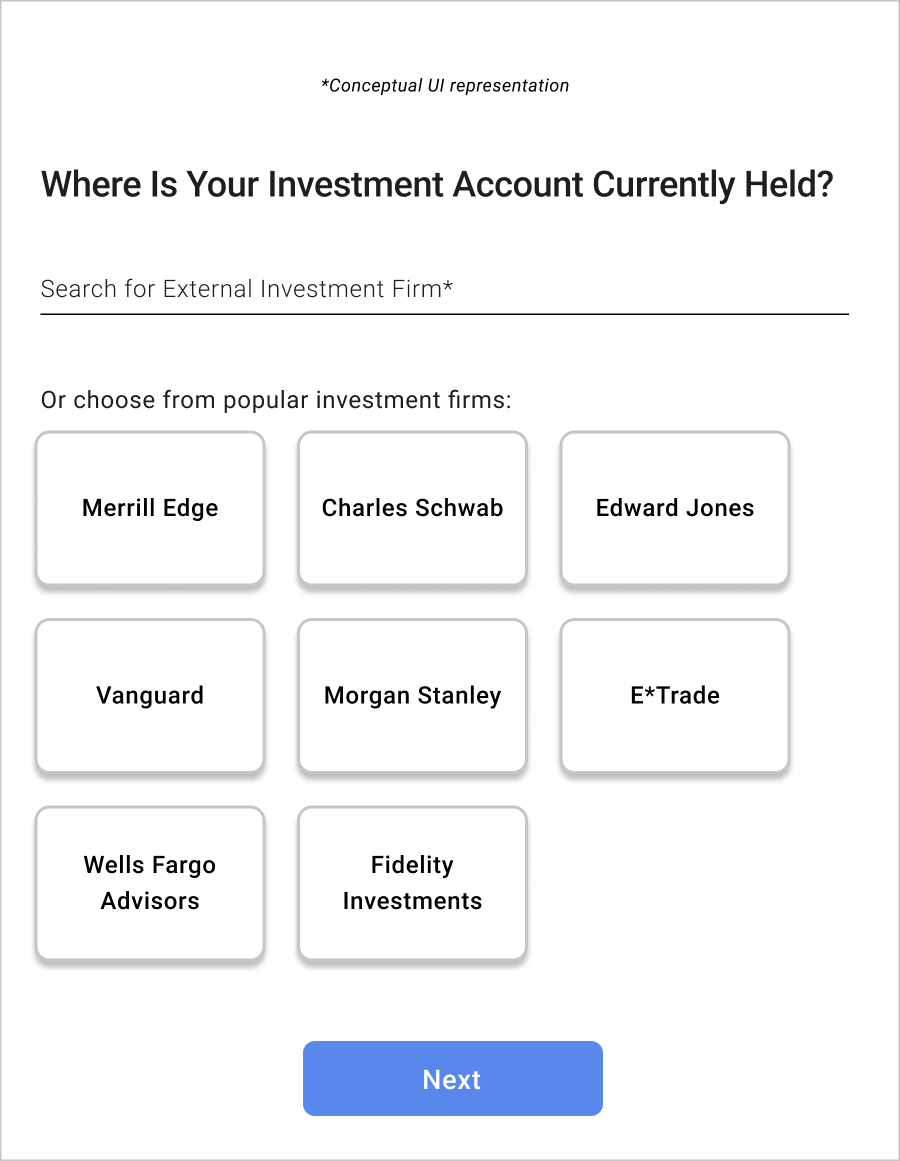
Decision Slice 1 — Identify External Account
Establishes the transfer source and enables the system to validate the external institution and account type.
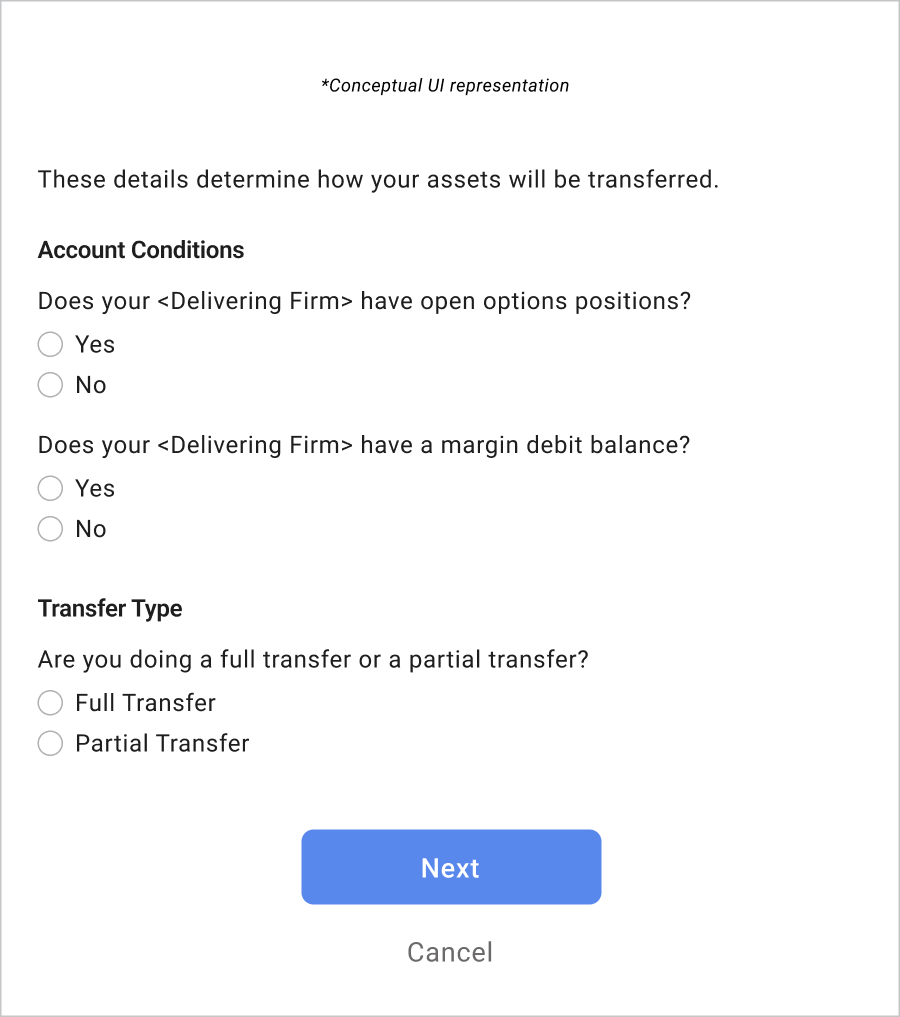
Decision Slice 2 — Define Transfer Conditions
Captures key transfer attributes (full vs. partial, asset types) that determine eligibility, processing rules, and potential constraints.
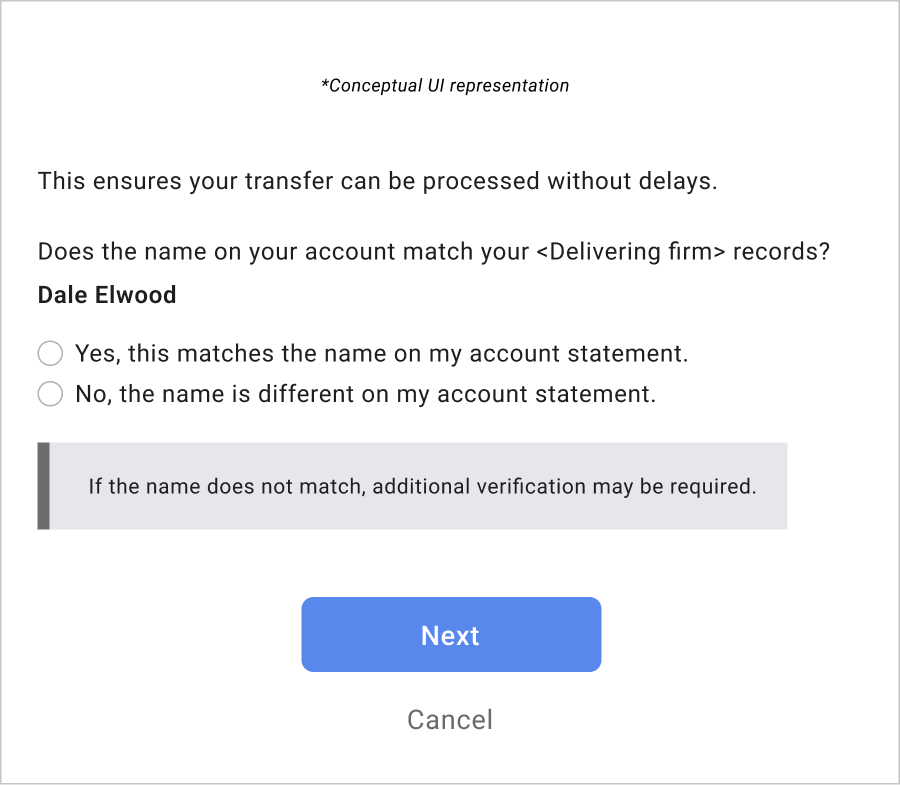
Decision Slice 3 — Verify Ownership
Validates account ownership to meet regulatory requirements and prevent transfer rejection or failure.
Decision Slice 4 — Review & Authorize
Confirms transfer details and applies digital authorization, triggering system processing and downstream workflows.
Outcome
This work established a unified funding framework that restructured how clients move money into investment accounts — consolidating fragmented entry points into a single, system-driven experience.
Beyond improving usability, the design introduced scalable patterns for authorization, account verification, and transfer orchestration — creating a foundation that can be extended across future financial workflows.
By shifting complexity from the user into the system, the platform reduced operational dependency and enabled clients to confidently complete high-stakes transactions independently.
WHAT I WOULD EXPLORE NOW
As this system evolves, the next phase focuses on expanding funding beyond traditional transfer models into fully digital workflows.
I’m currently exploring a Non-ACAT digital funding experience, enabling clients to initiate and complete transfers without relying on legacy ACAT processes — extending the system into faster, more flexible funding paths.
In parallel, future enhancements include dynamically surfacing eligible funding methods based on account state, introducing real-time transfer visibility, and reducing operational friction through smarter validation.
Together, these directions continue shifting complexity into the system while increasing transparency, speed, and client confidence in high-stakes financial transactions.
WHAT THIS CASE STUDY DEMONSTRATES
This work demonstrates my ability to design complex financial systems by transforming fragmented workflows into structured, scalable frameworks.
I specialize in shifting operational and cognitive complexity into the system — enabling users to complete high-risk transactions with confidence while maintaining strict safeguards.
By establishing reusable patterns for funding, authorization, and transfer logic, I create foundations that extend beyond a single feature and influence how future workflows are built.
My role goes beyond interface design — I help define system behavior, align cross-functional teams, and shape product direction at scale.

OTHER NOTEABLE PROJECTS
Investments Brief Page
Shared Access Experience
Trading Page Enhancements
Incorporating Real Time Quotes
Margin Balance Feature
Unsettled Cash Feature
Quote Draw Lookup with Watchlist Confirmation
Account Summary Mobile App Redesign For Investments
PNCI Responsiveness Graph Visualizations
Designed for Accessibility Purposes Incorporated
Negative Values and Graph Visualization for Net Worth Page
Integrate a Quicken Experience Feature
Account Actions Shortcuts
Digital Advice
UX RESEARCH & DESIGN
STASH
Welcome to the party.